Showing posts with label Alexandria. Show all posts

Wednesday, April 24, 2013

The Spectacle and the Badge

Photo courtesy of Shorpy.com

 
Spring had just arrived in Cherrydale the day before, but the chill in the air still suggested winter to the crowds gathering along Lee Highway on March 22, 1922.  The biting air didn’t stop the crowd of 600 including 20 or so reporters and at least one “movie man” to feel the electricity of anticipation. Around 10:30, the lights appeared on the hill above the hamlet and the crowd began to cry “They’re here! They’re here!”
On the crest of the hill the crowd saw the rambling stream of forty-six cars filled with 250 people puttering along Lee Highway with a Ford with DC plates at the lead. The cars had gathered at the Chain Bridge and made their way towards Cherrydale.  Onlookers had not turned out at this late hour to see the usual civic or patriotic parade and the lead car carrying a “huge fiery cross” told them tonight would be different. As the cars pulled into the center of town, the white robed contingent piled out of the vehicles to walk by foot holding signs that said “We were here yesterday, we are here today and we will be here forever” and “Our officers are sworn to do their duty”.
This was the Ku Klux Klan’s first major march in the DC area and everything about the evening was chosen carefully for a spectacle of white protestant institutional power to everyone gathered.  This would begin the Klan’s nadir of power as tens of thousands of men and women in DC and the close-in suburbs would flock to the organization. In Arlington alone, the Klan would claim, later in 1922, that “practically every male voter in good standing is a member”.  This was boastful swagger, but the fact that the claim could be made with a straight face proves the unnerving reality that Arlington was a Klan town.
As the parade pulled into Cherrydale, the men alighted from the cars and one of the photographers in the crowd snapped a photograph of one of the cars in the parade. It is probably a Buick with a DC plate and a Maryland plate. The number 590 on the DC plate tells us that the driver was someone of prominence since the lower number plates were reserved for important people in the community.
Above the driver side of the car was a small badge that read “Motor Corps H.D.L M.D.”, which signified the driver was a member of the Home Defense League in Maryland.  DC Commissioners formed the Home Defense League during World War I to serve as back up for the chronically under-manned and under-equipped DC police force during the strains for war. After the war, the Home Defense League continued as a citizen force made up of “public-spirited and patriotic men” that enforced traffic regulations and serve the police in times of crisis. During the war, most fraternal organizations formed units including many African Americans. Prominent auto dealers in DC worked to form the Motor Corps within the Home Defense League to serve as a rapid response group for police.
On January 25, 1919 a story appeared in the Washington Post declaring a “supposed maniac” had attacked three women in the city. Two women were shot and one was strangled during a daylong rampage by an unnamed man. The police force went into full alert and called out the Home Defense League for assistance. Evidently, the Home Defense League did not come through during the crisis and a month later, police held a reorganization meeting. Coming out of this meeting was a new Home Defense League that had dropped the “dead wood” from the organization. 
In June 1919, the director of the Home Defense League called members to action after an anarchist bombed the home of Attorney General Palmer in DC. The notice in the paper asked members to report suspicious persons and
All statements and literature that is in any way un-American should be forwarded to police headquarters, giving names and addresses of persons handling same.
The “dead wood” purged during the reorganization had freed the Home Defense League to take on the role of enforces of the conservative order. During this time, many white Protestants joined conservative organizations fighting to preserve the social order against blacks demanding civil rights, immigrants fighting for a new political order, and radicals working to win a fairer economy. Many of these organizations were dominated by important Protestant small businessmen that sought an idyllic orderly society with their caste on top.
In July 1919, whites in DC formed mobs along Pennsylvania Ave. as news spread that a black man had been questioned by police for sexually assaulting a white woman, but police released him after finding no evidence. The whites marched into Southwest DC and began days of rioting quelled only by rain and cavalry. Unlike many race riots of 1919, DC blacks fought back and formed bands of armed men confronting mobs of whites with violence.  The Home Defense League actively participated in the riots and was implicated in at least two murders.  A black rioter had no doubt which side they were on when he gunned down two Home Defense League members in a gunfight at 9th and M, NW.
Shortly after the riots, the Home Defense League strengthened their organization by forming a Motor Corps led by prominent auto dealers in the city. The Motor Corps pledged to be ready at a moment’s notice to provide assistance to the police. Led by W Pearce Rayner, a local businessman and anti-socialist crusader, the Motor Corps became the backbone of law and order in the city.
These conservative organizations found their real strength in the suburbs, where vigilantism came in the form of a real war on the disorder of liquor, philandering, gambling, and other vices. The strip of land along the Potomac from Rosslyn south to Alexandria housed small hamlets built around vice and a large swath of marshy land perfect for bootleg liquor stills. Jackson City sat on the end of the Long Bridge where the new shiny Long Bridge Park sits and was a sanctuary of sin. Built with so much promise as a tribute to Andrew Jackson, the community became the District’s gambling hub and the owners had visions of a Monte Carlo on the Potomac. Conservative citizens formed a vigilante band and razed Jackson City to the ground. The vice simply picked up and moved to the African American slum called Hells Bottom located roughly at the base of the Air Force memorial.  Police raided the area regularly and found illicit liquor production on barges along the Potomac and a booming gambling industry amid the garbage dumps and slum. This strip of vice spread up to Rosslyn where a few gambling and drinking establishments hugged the Aqueduct bridge operating openly through legal manipulation and graft.
These vigilantes were not just concerned with vice; they also worked to ensure that African Americans stayed in their place in the social order and showed a willingness to turn to violence if needed. In 1897 a crowd took a young black man out of his jail cell in Alexandria and carried him to the intersection of Lee St. and Cameron where they cheered as a group hanged him by a lamppost.  The lynching shocked the community and led to a better protection of African American prisoners. Nonetheless, for decades to follow, law enforcement officials faced vigilante mobs threatening lynching. As late as 1917, officials had to hide smuggle out a black prisoner from a jail in Ft. Myer Heights as a mob gathered outside.

All of this led to this day in March and the Klan proudly flaunted its numerical strength as well as institutional power in the form of a Home Defense League badge.  The Klan arrived in Cherrydale long enough to pose with an American flag and signs reading “We are for law and order” and “We were here yesterday. We are here today. We will be here forever.” The signs suggested the permanency of white protestant power while sending a warning to the “wets” that prohibition would be enforced by the Klan. 

From there the parade took a snaking route through population centers in Ballston and Clarendon with the Klan stopping briefly in each place to display their signs. The stops in these places were for recruiting purposes because this was where the base of the Klan would have lived. Unlike the later Klan of the sixties, the twenties Klan consisted of well-placed small businessmen and tradesmen who were pillars of their community.

After this stop in friendly territory, the parade then took a purposeful route into the territory of the Klan’s enemies.  The parade turned onto Key Boulevard and through the heart of the small African American quarter of Rosslyn. This would be a tense moment in the parade as the Klansmen stopped briefly for reasons left unexplained in newspaper accounts.  Community members turned out in the streets to heckle the marchers and violence seemed a distinct possibility in the cool March night. The 1919 riots showed African Americans in the DC area that blacks could stand up against vigilante violence and gave the community a sense of pride as they faced such intimidation.  In some cases, the black community in Northern Virginia organized armed bands to protect against lynching. In McLean in 1895, blacks armed with shotguns stood down a white lynch mob outside the constable’s house as a young African American suspect cowered inside.  The Klansmen and the black residents of Rosslyn confronted each other with this history boiling inside.

Just as the friction between the two groups seemed headed to physical confrontation, the parade lurched forward towards its terminus at Dead Man’s Hollow. The Klansmen turned back to Lee Highway passing Dead Man’s Hollow, which was a notorious hideout of highwaymen and killers located roughly at the base of the Key Bridge Marriott’s parking garage. Here the ruffians from Rosslyn would dump bodies and roll cash-rich farmers as they left the markets of Washington.  Did the local thugs watch the parade warily from their roosts and did the Klansmen gaze into the woods hoping no gunshots rang out?  The spot frightened locals after dark, so even the numerically superior Klan marched cautiously past the hollow.

The parade was a brief moment in the struggle against disorder by conservatives in the DC area.  As the Klan rocketed towards power, it appeared their vision of America could be a real possibility. Internal strife and corruption would split the Klan and Arlington would be no exception.  However, their legacy would endure in both the positive and the negative. On the one hand racism and intolerance would persevere right up to the days of the Nazi Party in Arlington, but  the Klan’s demands for a clean county government would also nourish the movement that brought Arlington a more open government.  

Monday, November 28, 2011

The Tullers: The communist cell in Alexandria and the Murders that Shocked Washington

On October 17, 1972, Charles Tuller turned in his resignation from his middle management job at the Department of Commerce. He would go on a leave of absence until the resignation became official on November 4. Tuller cited his diabetes and recent double hernia surgery as his reasons for stepping down. Colleagues had noted he looked like “death warmed over” so it didn’t come as a shock. Tuller was dedicated and worked hard at his job delivering government aid to minority businesses and many coworkers knew him as thoughtful and considerate. On the other hand, he had acquired odd views and had become obsessed with communist revolutionaries. Tuller’s coworkers and supervisors didn’t realize that the resignation was the catalyst that put in motion a carefully choreographed sequence of events.

On October 21, Charles’ son Bryce went on a three day pass from Ft. Bragg and would go AWOL when he didn’t return. Another son, Jonathan, called in sick from his lineman job at Vepco complaining of flu symptoms. William Graham, a family friend and former classmate of Bryce at TC Williams, went AWOL from his truck repair job at Ft. Benning. The four men gathered at Charles Tuller’s apartment at 3807 Executive Avenue in Alexandria, but they were short one man that backed out at the last minute when he realized they were serious about their plot to start a revolution in the United States. The Tullers had just moved into the apartment, which was in a building full of transient Washingtonians.

On October 24, Bryce and Charles went to American International Rent-a-car in Crystal City and procured a car. Charles signed as himself while Bryce signed his alias, J. Santino Wilson, a name also listed on their apartment’s lease (mysteriously, the clerk at the rental car place was adamant that Bryce’s picture did not look like the J. Santino Wilson who signed the rental agreement). Probably that evening, the plotters stole a C&P truck and uniforms from the lot at 115 S. Floyd St.

The next morning, William Graham and Charles Tuller drove their rental car towards Crystal City after leaving their brown 1967 Mercury Cougar at 20th and S. Fern St. The two Tuller sons, dressed in C&P uniforms, drove the stolen C&P truck and parked it on the corner of S. 20th and S. Clark St. next to a manhole that contained the telephone lines for the Crystal Plaza Complex. Amid the hustle of the morning rush, the two men would have been inconspicuous as they climbed into the hole and cut off the phones and alarms for entire area. However, as they worked the Assistant Residential Manager for the Crystal Plaza apartments peered down the hole out of curiosity. One of the men told him that water had “got into the splicing.”

Meanwhile, inside the Arlington Trust Company at 2001 Jefferson Davis Hwy something seemed strange when the phone lines suddenly went dead. One customer joked to the assistant manager “it’s a perfect time for a robbery.” Inside, Charles waited for his two sons and inquired at the Crystal World Travel Agency about the Alleghany Airlines schedule that day. At 10:30 AM on October 25, 1972, the Tuller sons, dressed as telephone repairmen entered the bank and told the manager they were there to repair the phone lines.

As they entered the bank, Charles followed and sat in the bank lobby unnoticed in the typical Washington dress of a shirt and tie sat. William Graham stood outside the back door near the getaway car. The two Tuller sons told the bank manager, Harry Candee, that they needed to get to the telephone box, so he escorted them to a back room. They entered the room, shut the door and told Candee it was a hold up. Candee resisted and they hit him with a blackjack. A teller, on her break in the back room, began to panic and may have screamed. As Candee continued resisting, one of the Tullers fired his gun, which mortally wounded Candee and grazed the bank teller.

At the same moment, the Cuban-born Arlington police officer Israel Gonzalez entered the bank and walked past Charles Tuller. Stories differ on why Officer Gonazalez entered the bank. He was either alerted by an employee unnerved by the dead phones or he was doing his routine check of the bank. Whatever the reason, he walked through the door as shots were fired in the back room. Gonzalez drew his gun and came into a glass hallway where he saw the Asst. Bank Manager open the door to the break room. Out of the room dashed the Tuller sons and Gonzalez fired two shots before the Tullers returned fire. When Charles Tuller saw this, he drew his gun and ordered the employees and customers on the ground. As Gonzalez and the Tuller sons exchanged fire, Charles Tuller shot him in the back causing Gonzalez to fall through glass doors leading to the back of the bank. As he lay dying from six gunshot wounds, Gonazlez managed to fire his gun and shoot Jonathan Tuller in the hand.

In a panic, the Tuller sons headed out the door towards 20th St. while Charles Tuller ran out the door leading to the apartment building. All three joined Graham on S. Clark St. and they piled into the getaway car. They left behind $160,000 in the bank vaults and a bloody scene of panicked customers and employees. With Jonathan bleeding from his wounded hand, the four men drove on S. 20th St., crossing Jefferson Davis Highway to S. Fern St. where they exchanged cars. Once they got into their other car, they headed south rushing away from the scene with their original plan in tatters. At some point they arrived in Winston-Salem where a friend of Bryce unwittingly gave them a new car. The generous girlfriend would arrive home to find her house surrounded by police hot on the trail of the bank robbers.

Charles Tuller remembered from his business travels that there was a surgeon in Houston he could trust. As the four men sped 1500 miles south west, they were in constant fear of the police. At one point, in Georgia, a state trooper passed them with his lights flashing and as he drove by, they held their loaded weapons ready to kill. Later, they stopped at a truck stop and one of the robbers, with a gun in his jacket, ran right into a police officer. There was tense moment before the officer said “excuse me.”

Five days after the robbery, the four men showed up at the Houston airport on October 30 and approached the gate of an Eastern Airlines plane boarding passengers headed for Atlanta and Syracuse. They waited until all the passengers had boarded the flight and Charles Tuller, leading the others, stormed the ramp of the plane. A ticket agent named Stanley Hubbard tried to stop Charles and they fell to the ground wrestling over his gun. Charles was able to pull the gun away and shoot Hubbard in the stomach. As Charles got up, Bryce Tuller shot Hubbard in the head. Hubbard lay dying, still holding Charles’ jacket as the four men rushed the plane. Outside, Wyatt Wilkinson refueled the plane when the engines suddenly started. Realizing the extreme danger of fuel and running jet engines, he ran into the terminal to get the plane to shut off where he found Hubbard and called an ambulance. He rushed down the ramp where he was met with gunfire and was hit three times, but survived the wounds.

The four hijackers stationed themselves throughout the plane and ordered the pilot to fly to Cuba. They told passengers to keep their hands on their heads for the entire 4 hour flight while Charles ranted over the intercom about his revolutionary leanings declaring “the revolution has started!” One African American passenger, Ron Pinckney, news director at WOL radio, had a gun pointed to his head and Charles asked him “What’s the matter black man? Are you afraid to die? Blacks who do not fight and give into the white man are slave niggers.” Charles then turned to another man and asked him what he did for a living. The man replied that he worked for IBM to which the Tuller replied “I didn’t like your looks when you got on! I should have killed you then!” The plan flew to New Orleans for refueling and went on to Cuba where the hijackers got off the plane and released the crew and passengers. The terrified hostages made it back to Miami the next afternoon. The four hijackers went into Cuban custody with no resistance.


Unfortunately, hijacking was a rather routine event in 1972, but Washingtonians would be shocked to learn that this band of radicals were locals living a typical Washington life, at least superficially. Since 1968, the US alone had 364 airliner hijackings with most of them being diverted to Cuba, but these hijackings had roots in a CIA tactic in which planes were hijacked from Cuba to the US to sow fear and confusion in the communist regime. After the CIA employed the tactic, leftists in the US began copying it as a way to gain entrance to the closest communist country. Cuban authorities considered these hijackers either CIA patsies or mentally ill, so they usually ended up in prison. The Tullers hijacking would accelerate FAA security changes already in the works leading to a comprehensive bill would pass Congress the next year. The changes brought universal screening procedures including bag inspection and scanning of passengers. As part of this comprehensive package, the CIA ended the use of hijacking as a covert action in Cuba and the US reached agreement with Cuba to prosecute or extradite hijackers. The Tuller group would be among the last hijackings on US soil and the deadliest, but a new wave would begin shortly, by radical Muslims borrowing tactics developed by leftist revolutionaries.

In addition to being among the last hijackings in the US, the Tuller band was the part of the rear guard of a fading movement. Communism was all but dead in the US and even among student radicals, communist philosophy held sway among only small militant groups. Nonetheless, the actions of the Tuller group would resuscitate quiescent fears of communist infiltration in government that were fading in Washington under a rising obsession with the deficit. By 1972, Washington was changing as conservative ideas began surpassing the New Deal, which was struggling to revive the economy. The old liberal constituencies were moving out of the mainstream of Washington as the once mighty coalition splintered. The splintered left brought out increasing frustration in the far left and this frustration bubbled into a series of violent events in the seventies. Tullers’ militant cell emerged out of nowhere in Alexandria, apparently disconnected from any other left-wing organization.

Tuller considered his group patriotic and the New York Times described him as “a handsome, aggressive, $26,000 per year bureaucrat who apparently believed the American dream could belong to everyone and worked to make it so.” However, beneath this hard working middle manager was anger at “the system” and its “oppression of blacks.” Racked with diabetes, Tuller became mentally unstable over the years and began turning to militancy as he became less satisfied with how the United States treated African-Americans. Tuller worked hard and could be charming, but could sputter with rage if “the system” held him up.

Tuller grew up comfortably in Toledo, OH, but when he was 9 his 4 year old brother was run over by a truck for which Tuller’s dad blamed him. Tuller later claimed, as his dad was on his death bed, he told Charles he would never forgive him for the death of his brother. This event shaped Charles’ life and would slowly erode his rationality. For years Charles would see a psychiatrist in New York as he dealt with his racking guilt. Despite this, Charles showed much promise in life as a man dedicated to helping others. Sometime in the early fifties, perhaps while attending college in New York City, he became involved in the civil rights movement. Living in Newark, NJ, he rose to a leadership position in the local chapter of the Congress on Racial Equity while working as a welfare case worker. Eventually he joined Attorney General Ramsey Clark’s Justice Department despite some concerns about his emerging leftist views (ironically Ramsey Clark would go on to become a Stalinist as the head of the International Action Center). Tuller would move through a few government jobs before landing in the Commerce Department where he specialized in helping minority businesses. He pursued the job with vigor, but he began to feel that his work was treating “symptoms and not the causes” of poverty and inequality.

By the late sixties he grew to hate white people and believed in standing with black and brown Americans over white Americans. A neighbor said “he was always ‘aginer’ and “against everything and everybody.” Around this time he embraced the philosophies of leftists like Mao Tse Tung and Che Guevara. Tuller probably found in Mao and Guevara a theory of empowerment for disenfranchised people and a way for them to organize to take over the power structures that oppressed them. Mao was leader of the Chinese revolution who developed a set of theories based on independence from the Soviet Union and distinctly Chinese solutions to problems. The revolution in China led to a new communist superpower that would not be subservient to the Soviet Union and would lead to global break-up of the communist movement. Mao introduced the “Three Worlds Theory”, which placed the US and Soviet Union in the first world, Europe and other developed countries as the second world, and the poorest unaligned nations as the third world. Mao believed the oppressed people of the third world would lead the Marxist revolution and, by extension, people of color were the revolutionary masses while white people were the people of privilege and counter-revolutionists.

Che Guevara admired Mao and believed he could extend his revolutionary theories to the peasants in South America. Admirers of Mao and Che in the US applied these ideas to say that white people in the US were the beneficiaries of “white privilege” and because of this they would tend to be counter-revolutionary. Thus, any good Maoist would align themselves with black and brown people because these people are the true proletariat. This simplistic view of American society led many Maoists to naïve views of poor and working class Americans which hampered their organizing. In other words, not many black folks want to overthrow capitalism and most white people are not fascists, which leads to a rapid breakdown of political theory for Maoists operating in the U.S.

Tuller didn’t embrace the American Maoists and sought an independent road. Perhaps viewing himself as a communist philosopher in his own right, Tuller never joined a communist organization because he felt they were too much in service to foreign governments. He took Mao’s nationalist independent views and applied them to the US where he hoped to recruit a revolutionary coalition of small farmers, small business owners and poor people to rise against the powers. True to the tactics of Mao and Che, he hoped, by organizing a small cadre, there would be a mobile and agile group of revolutionaries able to help local people take direct action. He considered his views to be “100% American”, patriotic and improving the lot of the people at the bottom of the heap.

Charles’ militancy and mental deterioration caused problems in his personal life. His wife, Edith, whom he married in 1949, put up with torrents of emotional abuse. If Charles needed someone to yell at, he would call Edith and tell her she was “a no good bitch”. Charles associated Edith with “the system” and had affairs with black women. He played out his frustration with whites by flaunting black girlfriends in front of coworkers and his wife challenging the sensibilities of the still very southern Washington area. When Tuller traveled to Houston on business he showed up at an office Christmas party with a black woman as his date causing uproar in this deep southern city. After the incident, his superiors had to ban him from travelling to Houston, which may have been part of his motivation for returning to the city and hijacking a plane. Tuller’s erratic behavior and infidelity forced his wife out of the house in March 1969 and their divorce became final in October 1971. Edith gave Charles custody of Bryce and Jonathan, who were attending high school at the time.

Charles remained close to his sons and was lenient with them. Their relationship, especially with Bryce, was more like friends than parental. The boys embraced their father’s leftist sympathies and joined the Students for Democratic Society chapters at Annandale High School and later TC Williams. When Bryce attended Annandale High School, he started an underground newspaper supporting leftist causes and caused a stir among students. The leftist activities of his sons caused Mr. Tuller to go to school often to defend them. He would use this time to rail against the system and threaten the principal. The Tuller house on Fontaine St. became a gathering point for a small group of radicals, which coalesced around the plot to rob a bank and start a revolution. By the late sixties, Charles Tuller’s ivy-league dress, cropped hair, and horn-rimmed glasses had evolved into long hair and a beard. At the time of the hijacking he sported a handle-bar moustache. When police searched his home they found marijuana plants growing in the back yard, parachutes stashed away, and piles of leftist propaganda.
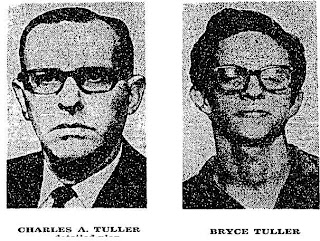


As police learned in the days following the bank robbery, the hijackers had carefully planned the heist. Bryce Tuller sought training with the phone company as a cable splicer so he could learn which wires to cut and joined the army in February 1972 to learn to shoot a gun. Jonathan went to work at VEPCO to learn similar wiring skills. Charles Tuller robbed the First Virginia bank branch in Woodbridge of $5,822 in April in order to practice for the Crystal City holdup and to raise the funds needed for the bigger heist. Charles Tuller acquired at least one Lugar and went to Hunters’ Haven in Alexandria to buy a shotgun. The plotters regularly went camping to practice shooting their guns.

By the middle of 1972, the Tullers and their co-conspirators had settled on their plan. They were going to rob the bank in Crystal City and flee to the back woods of Canada where they could develop a leftist revolutionary commando unit. They hoped this unit could infiltrate the United States and organize a revolution. Charles Tuller believed this vanguard would incite a coalition of middle and working class Americans to rise up against capitalism.

When the plot went awry and two people lay dead, a bewildered city struggled to make sense how one of their own could go so crazy. They saw a man like many in this city who got up every morning and worked to help people with little or no thanks. Tuller was like many in the federal government, but he finally cracked. Shortly though, the media narration reverted to days of the red scare as an old familiar paranoia set into the city.

The Tullers actions brought back old red scare hysteria and briefly whipped the Washington establishment up as their old anxiety about communist infiltration of government came back to life. The columnist Victor Riesel reported that Tuller had been busted engaging in gay activities in New York and accused him of being involved in the incredibly square sounding “white bohemia”. This was a common accusation hurled at leftist activists as support for gay rights conflated with being gay. As Joe McCarthy succinctly put it, only “communists and cocksuckers” were against the anti-communist witch-hunt.

However, it would have been surprising if Tuller was gay given his devotion to the totalitarian wing of the left and his well-know dalliances with many women. The communist regimes that Tuller admired were strongly anti-gay, often considering it a mental illness or the result of capitalist excess. Neither Cuba nor China tolerated gays at this time and have been behind the US in recognizing the civil rights of gays. Perhaps Tuller encountered fellow leftist who were gay, but it would be strange for him to be devoted to Mao and supportive of gays.

As some columnists tried to stoke hysteria, others struggled to piece together an explanation for Charles Tuller and his followers. Newspapers published profiles of Tuller, but they couldn’t arrive at a rational reason for Tuller’s madness. Some tried to portray him as deviant, some blamed childhood trauma, and some placed him in the context of a wider civil rights movement, but none could make sense of the three dead men.

As the media worked to put together a narrative, government officials faced a nightmare scenario. Reporters wrote about Tuller’s work ethic and passion, but simultaneously wondered how a guy with such radical views could get a job with the government. Through conversations with all the people in Tuller’s life, it was clear that he was good at his job and could be a very charming guy, but people were also troubled by his views and temper. This put government officials in a difficult spot because if they fired him for his communist views, they risked seeing a headline about reds infiltrating government and if they accused him of mental illness, they had a high legal hurdle to leap. Given that he was doing well at his job, his supervisors did nothing, which proved to be a bad decision.

Newspapers began calling for the establishment of an Employee Security Board to root out radicals in government despite it being clear that the government was not overrun with reds. Roger Wilkins, who had recently gone to work for the editorial page of the Washington Post, hired Tuller in the Commerce Department, but he told reporters that Tuller “struck people in a mean way” and he told his successor at Commerce to watch Tuller. However, no one took any action against him during his time.

As Washington debated what the robbery and murders meant, the Tullers and Graham landed in Cuba and were immediately taken into custody. They were held in solitary confinement for months and given little food and no new clothes. Once released the Tullers were sent to labor in sugar cane fields, which they would later describe as “a living hell”. The Tullers wanted to leave after the first day, but Cuban authorities would not allow them to go. They barely subsisted for months in a rundown hotel with no running water and ate mostly rice. Later, Bryce Tuller claimed they were “starving to death” during this time. At night, in a nearby courtyard, they could hear the firing squads execute anti-Castro Cubans.

On the other hand, Graham was studying languages and history at the University of Havana by 1973. In his off time, Graham enjoyed swimming and volunteered for construction crews building apartment houses. He condemned the Tullers as the murderers of the three victims in the US and declared that he had broken with them. Charles Tuller was angry with Graham because he blamed his sloppiness for the murders in the US and Graham decided that Charles Tuller was mentally unbalanced. By 1975, Graham has left the University and had become a night foreman at a print shop, which his mother would only describe as “involuntary.”

Charles Tuller’s health turned for the worse in Cuba and he may have been hospitalized after a heart attack. On June 20, 1975, Cuban authorities gave Charles and his two sons $1,400 and some false identification papers. They put them on a series of flights leading to Miami. Amazingly the trio walked through the airport undetected and entered the United States. As they made their way back to Alexandria, they attempted to rob and Kmart in Fayetteville, NC. Bryce Tuller entered the manager’s office and showed his sawed-off shotgun under his coat. He took the cash and demanded the safe be opened. As the safe was opened a security guard distracted him and an enterprising manager grabbed a stool leg and began beating Bryce. The police arrived to find Bryce held at gunpoint with his own shotgun.

Charles and Jonathan fled the Kmart reaching Alexandria where they checked into a hotel and laid in bed with their shotguns. When they learned that Bryce was in jail, they decided it was time to turn themselves in. They went to the Washington FBI field office in the Old Post Office building and told the security guard that they wanted to see an FBI agent. They were sent to the fifth floor where they found an agent and told him calmly they were wanted for bank robbery and murder. The head of the DC field office recalled, “I had just come back from lunch and someone told me Charles Tuller and his son have just surrendered.” He went on to say “I’ve never been so surprised at anything in my life.”

As the Tullers stood before the judge, they wore the same clothes they had on the fateful day three years earlier. After a short trial the judge sentenced each of them to 100 years in prison. Shortly after his conviction, reporters interviewed Charles Tuller who said he had “no regrets” about shooting Officer Gonzalez in the back. When bank manager Harry Candee came up, he snickered calling his death “unfortunate” and saying “I guess he was doing his job the way he saw it”. In the end, Tuller considered his actions honorable and done for the greater cause of his country.

The sage of the Tullers didn’t end with their convictions. In 1984, Bryce Tuller seized an opportunity and escaped the Bland Correctional Center near Roanoke by walking past a guard and through an unlocked door. He remained on the lam for 2 days before police caught him walking along Interstate 77 near the West Virginia border exhausted from his time in the woods. In the late seventies, William Graham slipped back into the US and federal authorities got wind of it, but they couldn’t find him. Graham moved to San Francisco and had a successful career until he saw his case on America’s Most Wanted in 1993 and decided it was time to end his run from the law.

Today Graham, Bryce Tuller, and Jonathan Tuller are serving life sentences while Charles Tuller died in prison in 1988.

Sunday, August 14, 2011

The Ku Klux Klan and the Redneck Mafia in the twenties

The Ballston Klan No. 6 gathered on their field
The Ku Klux Klan probably arrived in Northern Virginia in 1921, but the organization didn’t rise into prominence until March 1922 when four hundred members marched from Chain Bridge to Falls Church passing through Clarendon, Ballston, Cherrydale, and Rosslyn. The marchers carried signs saying “We are for upholding the law”. According to one report, Northern Virginia had about 60,000 KKK members in the twenties, which may have been as much as two-thirds of the state membership, with the largest regional chapter being the Ballston Klan No. 6. The Ballston chapter held regular parades with its own marching band, sponsored a youth baseball team, and owned a field for cross burnings and other ceremonies at the current site of Ballston Mall. Of course this was the second coming of the Klan, which had risen from the ashes of the Civil War in the south avenge perceived wrongs such as equal rights to blacks. The first KKK was a terrorist organization enforcing racial codes in the rural south, but the second KKK was an urban fraternal organization obsessed with preserving its own brand of Americanism. The new KKK worked to minimize the influence of the newer white ethnics of Catholic and Jewish faiths while continuing to fret about blacks attempting to gain equality. Beyond this, the Klan worked for moral causes, threatening bootleggers, gamblers, and home wreckers.

Virginia passed liquor prohibition in 1916, one year before Washington DC, and four years before the federal law. The Klan aligned with the Anti-Saloon League and the Women’s Temperance Union to pass the law and worked to enforce it when they perceived local law enforcement as too lax. The division over prohibition created splits in the community between “wets” and “drys” that translated into the Democratic Party. In many parts of Virginia, this split caused an internal civil war among Democrats, but in Northern Virginia, the Klan seemed to ally more readily with the Republicans. Locally, the Democrats were more liberal and included more ethnic whites whereas the Republicans tended to be conservative Protestants, which more closely aligned with the Klansmen.

By 1922 the Klan had gained significant membership in Northern Virginia, which Goblins (the title for recruiters) brought in by a practiced script and salesmen practices. The strategy that helped the Klan thrive was to split the initiation fee among many stakeholders and the Goblins making a similar living to any well-paid salesmen. One Goblin in DC sued the Klan for $15,000 owed to him for his recruiting activities, which gives us a sense of the amount of money the Goblins earned. However, the problem with broad incentivized recruiting is an organization may get large numbers, but it will inevitably recruit undesirable members. By the early twenties, the Klan had become a large organization made up of a broad array of people that included men involved for fraternal reasons as well as thugs joining for less noble reasons.

In many cases, Klan members tried to use their connections as a cover for crimes or would overtly invoke the KKK name to intimidate blacks, Jews, or Catholics. For example, on September 1922, a man named Frank Fields went to the home of a young black girl and claimed he was a member of the KKK before he attacked her. The article was not clear on the nature of the attack, but implied it was a sexual assault. What preceeded the attack is also unclear; it may have been simply drunkenness, thuggery, intimidation, or revenge. Frank Fields was involved in bootlegging and had been arrested for shooting at another man on North Pitt St. near King St. in Alexandria. As was customary for the Klan when a member was put in the spotlight, the KKK wrote a letter to Frank Ball, the Commonwealth Attorney, denying Fields membership in the Klan. However, it is hard to believe Frank Fields wasn’t a member because his brother, Howard, was running for Sheriff at the time against AC Clements with the vociferous backing for the KKK. Howard Fields and Clements would have a decade long rivalry rooted in prohibition in which Klan and other drys perceived Clements as being weak on gambling and prohibition, but Fields, at least superficially, supported prohibition.

They also accused Frank Ball of being intentionally laggard on prosecuting gambling, but Ball struck back saying the Klansmen were cowards because they make unsubstantiated charges. Ball was a liberal on segregation and would go to have a distinguished political career and ultimately represent Arlington in the desegregation of the schools. Ball summoned the Klan to appear in front of a grand jury to show proof of their charge, but when the Klan members gave testimony; the grand jury could find no proof that county officials were culpable. However, the Klan regularly sent members and associates out to case gin joints or gambling rackets and in one case this amateur detective work paid off because police busted a gambling ring at the Hilltop Country Club in Arlington. Police raided the country club and found gamblers including the lookout George Mater from Bladensburg – a known thug and bootlegger.

Meanwhile in Alexandria in late 1922, the Klan had enough with bootleggers and gamblers, so they hung placards across the city so residents would wake on Monday morning to a warning, "We are here because certain conditions demand out presence. We know within the city of Alexandria the bootlegging traffic is increasing to alarming proportions. The authorities are apparently unable to cope with this deplorable situation."  The signs alerted residents that the Klan would be collecting evidence on bootleggers and gamblers to turn over to police. The newspaper noted that many Alexandrians snickered at the signs not believing the KKK had the strength or reach to put a dent in the thriving illicit industries. However, the Klan paid for a Private Investigator to mingle with bootleggers and pinpoint the speakeasies. In 1923, the Private Investigator held a party with a bunch of his new bootlegger friends, but it was sting for police to arrive and arrest them. That same month, police raided two speakeasies, the Majestic Lunchroom on King St, arresting Peyton Ballenger, and the Black Cat on South Union, arresting Leroy Beach based on evidence gathered by Klansmen.

Despite this crusade on behalf of the drys, the local KKK officials grew increasingly worried about the public perception of them as a violent organization. In March 1923, they felt the need to tell county authorities that they would help prosecute “people who make threats in the name of the KKK” and reminding them that “any communication of our order, is written on official stationary and signed by some officer of the organization.” Clearly the organization was doing well in publicity, but at the street level many perceived the organization as a group of thugs. While street level violence undoubtedly occurred under the banner of the KKK, the Northern Virginia chapters engaged in intimidation too subtle for newspapers to pick up. For example, the Ballston Klan would organize parades through the county in cars laden with food and clothing for the needy. Conveniently, many of these needy folks were Catholic, blacks, and Jews that the organization railed against in their rallies. Imagine the terror of being a black family visited by a parade of Klansmen dropping off food and clothing. While the act gained positive press, it was clearly intended to frighten foes without the messiness of violence.


Klan distributing baskets

The strength of the KKK grew into Election Day 1923 when they successfully elected Howard Fields for Sheriff. Fields had served before, but AC Clements had defeated him in the prior election. Fields alleged that Clements had beaten him organizing bootleggers and gamblers, which Clements denied. It is pretty clear that Fields was a member of the Klan because the chair of his election committee was Howard Bitting who would go on to be the leader of the Ballston Klan in the thirties. Clements was allied with Frank Ball and was Catholic, which was the ultimate disqualifier for public office in the eyes of the Klan. Fields was a true believer and allegedly promised to bring a second heaven to Arlington, but he regularly pulled strings for fellow Klansmen such as EE Naylor, whom he helped get out of a ticket for an expired auto tag. The Klan was so excited to have one of theirs leading law enforcement in the county that they had an impromptu parade across the county including 75 cars with the two leads boasting 8-feet tall crosses lit up.

Strangely, a few days later a group of men dressed in KKK regalia passed a saw to two inmates in the Arlington jail so they could cut the bars and escape. One escapee was Earl Blundon who was a lifelong criminal involved in burglary, bootlegging, and other crimes. Arlington police searched for him, getting so many tips from fellow bootleggers that police wondered if he had made enemies with other Arlington criminals. Perhaps Blundon had become allied with another group of bootleggers and the other criminals wanted him out of the picture.

In the case of Frank Fields and Earl Blundon, the two threads that tie them together are bootlegging and the Klan. Could the Klan (or a faction within it) been involved in illegal activities? The evidence is thin, but persistent as we will see. In other parts of the country, local Klan chapters would The involvement of the Klan in bootlegging It was never clear whether the KKK really aided in the escape, but they may have had motivation in a desire the ultimately embarrass the outgoing Sheriff Clements. However, this was the first instance of a coming trend in the KKK being tied to bootleggers. In Western North Carolina, Klan membership meant protection for bootlegging activities and ensured rival blacks or Catholics would be exposed. In 1923, a minister in Mississippi complained that any bootlegger with $10 could join. Just as many people discovered during prohibition, the money in bootlegging was too good even for prohibition supporters.


Arlington Klan attending a funeral in the Bon Air neighborhood

In September 1924 the involvement of the Klan in bootlegging became more evident. That day three Alexandrians, CM (or TM in some articles) Hughes of 719 Gibbon St., Ward Stuart of 513 S. Washington St., and Andrew Pettit 717 Duke St., set out to DC with a truck intending to load it up with fruit jars of illegal booze. As they returned over the Highway Bridge (now the Key Bridge), they stopped to get soft drink at a store just on the Arlington side when police noticed their payload and tried to arrest them. One of the deputies jumped on the floorboards to stop the truck, but Hughes thrust a pistol in his face. Luckily the deputy was able to push the gun away before it fired. Then Ward Stuart pulled his sidearm and held officers at bay until they could speed away. Alexandria police arrested the trio later that day and Arlington police came to get them. On his way to the station, Hughes accused the deputies of roughing him up as they interrogated him trying to learn the location of the liquor he smuggled. Arlington deputies claimed that Hughes was beaten out of self-defense because he continued to resist after his arrest. Ward Stuart asserted that the incident started on a country road in Arlington when police started shooting at them and the trio didn’t know who they were.

Other members of the Alexandria Klan were involved in illegal activities such as Ernest Crump who, prior to prohibition, ran a saloon primarily serving blacks. Police busted him in 1904 and 1906 for running illegal gambling and liquor operations. When Crump died in 1925, both the Alexandria and Arlington Klan came out to hold a ceremony for him. People like Crump, Ward Stuart, and CM Hughes either lived dual lives as hardcore prohibitionists and bootleggers or the Klan permitted bootlegging among members only. It would be impossible for the Klan to be unaware of the activities of a bootlegger like Ward Stuart who was known as a tough bootlegger who worked his racket with his brother Richard. He lived on South Washington St. nominally working in jobs such as mechanic and painter, but earning most of his living through crime. As police closed in to arrest him after the incident in Arlington, he awoke from a slumber and drew his pistol before he realized it was the police. His brother, Richard, spent time in prison for hijacking at gunpoint a black man’s car full of whiskey along Route 1, perhaps enforcing the bootlegging turf of the Klan

Obviously, the evidence is slim that the Klan in Northern Virginia engaged in bootlegging, but given the organization’s history of doing it in other areas plus the events I’ve written about point towards the possibility. By the late twenties, internal splits and corruption would cripple the KKK and the national membership would go from the millions in the mid-twenties to the thousands a decade late. In Arlington, the Klan formed in the twenties would continue until at least until 1944 sponsoring a youth baseball team and meeting every Thursday at 8pm at the Ballston Firemen’s Hall. Of course, the KKK would emerge again in the 1960s, but as a fringe organization of extremely violent anti-civil rights whites.


Friday, May 28, 2010

Trouble at the Pool Hall

NOVA was home to dozens of pool halls serving as hubs for a lot of ilicit activities. One pool hall in Alexandria was the home to ongoing problems with drugs and murders. The building at 1101 Queen St. in Alexandria has an interesting history. It was built in 1921 and called the Lincoln Theater and was located in the heart of an African-American neighborhood called Uptown. The original building was replaced in 1939 and it later became the Capitol Theater. In the 1960s the theater continued to operate with "a pool hall and amusement arcade".

The pool hall was nothing but trouble. In 1961 police arrived to find a brawl outside the pool hall and tried to break it up. As a cop tried to take Douglas Beck's blackjack away, he got in one more smack on his victim. Beck's buddies James Allen and Nicholas Lafragiola were hauled in by police too. In 1969 Russell Robinson, who was a bouncer at the pool hall, was shot three times in the hallway of the pool room. Patrons told police that they heard gunfire and Robinson emerged clutching his throat. Charles Davis of 3627 S. Four Mile Run Dr. in Arlington claimed he shot Robinson in self defense because Robinson was trying to rob him. Davis was convicted to five years in prison.

In 1970 the Alexandria Vice Squad cracked down on the pool hall and arrested a lot of folks on drug charges and found it was a center of heroin dealing. It was likely that Guy Black's mini drug empire had its tentacles in the pool hall. He was the kingpin of the heroin market in NOVA for a few years. In 1975 Black was busted and cops found he had a $2.5 million operation that he was running while living in dumpy motels across Arlington. The heart of his drug operation was the Green Valley section of South Arlington, which is a historically black area of the county. Black had his junkies dealing out of teen centers, pool halls, motels, and shopping centers across NOVa.

An Alexandria Gazette article from 1970 notes the pool hall is the site of "frequent arrests for disorderly conduct, and several fights, and shootings have occured at the spot in recent months". In addition to heroin, the pool hall was the center of numbers betting in Alexandria.

Monday, May 24, 2010

The Drag Racing Menace

During the fifties and sixties the DC area was a hot bed for hot rodders. In NOVA hot rodders gathered at the various Tops Drive-Inn locations like Fairfax Circle, Harrison and Lee Highway in Arlington and Glebe and Rte. 50 in Arlington. They'd bring their cars to the drive-in and hang with their gang of friends. In some cases, the hot rod friends became clubs and sometimes evolved into greaser gangs. The greaser gangs evolved into the sixties and in some places continued well into the seventies. In PG County they were known as Grits during the seventies, but in NOVA some of them evolved into the Pagans.

In 1960 WaPo did one of a number of articles on the menace of drag racing in the DC area. Naturally the hotspots were the redneck areas of PG County, Arlington, and Falls Church. The Post reported that motorcycles, trucks, and even women were drag racing!

The drag racing hotspots in NOVA were (according to the Post): East Broad St. and Hillwood St. in Falls Church; Williamsburg and Yorktown blvds; George Mason and Sycamore; and GW Parkway.

Saturday, March 13, 2010

Massage Parlors and Old Newspaper Code

During the early to mid-seventies, massage parlors were very controversial in NOVA. In 1973 C&P changed their practices for advertising such establishments by doing away with suggestive pictures and sexual language. C&P had seen an explosion in ads going from 3 pages in 1971 to 10 in 1974. Falls Church tried to impose strict regulations to run them out of business, but was overruled by the courts. In 1974 Arlington invoked a rarely used bawdy house law to charge Ronald E. Kennedy for operating lewd establishments. According to a newspaper article he ran Inga's Superstar (1114 Wilson) massage parlor and Paramount Health Club (1100 Wilson). The article is a bit evasive about what went on in these places, but I guess we can all imagine. It's weird reading old newspaper stories and sensing the reluctance to talk about what was really going down at these joints.

Interestingly, a search of old phone books revealed that Mr. Kennedy also operated Honeybee Escort Service out of the 1114 Wilson Blvd. location. Also, the phonebooks show that most of these massage parlors were concentrated in certain areas. They all advertised their proximity to National Airport, but the area on Rte. 1 near the airport had a particularly high concentration. Rosslyn had a lot of massage parlors too, which isn't surprising because it was quite seedy back in the day.

One interesting parlor is Jenna's at 1134 N. Hudson St., which was next door to the famous Keyhole Inn. Rednecks need their chili, beer, and girls.

According to Senate testimony, the Pagans supplied the women to many of these massage parlors and served as bouncers. Sound like wholesome family establishments, no?

Below is a list of some of my favorites from the phone books:

Tiki-Tiki: 1073 Broad St. and 3219 Columbia Pike Arlington
Wolf's Den: 4613 Duke St. Alexandria
Alexandria's Shangri-La: 121 S. Henry Alexandria
Godfather I (with International Staff!):1801 N. Oak Arlington
Zodiac: 3520 Lee Hwy Arlington
Jenna's: 1134 N. Hudson (next door to the Keyhole Inn!)
Aphrodite: 3603 Wilson Blvd. Arlington

Tuesday, March 2, 2010

The Moral Panic in Northern Virginia

I’ve been doing a lot of reading about sixties motorcycle gangs in NOVA during the mid and late sixties. Reading the WaPo’s coverage from 1965-70 is reading a classic example of the media molding a moral panic out of youthful disturbances. The WaPo especially takes aim at the Pagans as the motorcycle gang grew from a few young men to a huge regional club. The coverage culminated with the murders of Newland and Hartless in 1970.

The first article to mention the Pagans that I’ve found is from late 1965. Warner Ray Cockerille was arrested at the Social Circle dance hall in Centreville for his involvement in a brawl. The article mentions as an aside that he was part of the “pagan motorcycle club”. This article lays the first building block in the construction of a moral panic by alleging Cockerille fought a group of girls despite his 6'9" stature. In constructing a moral panic, it is critical to show them as living outside the norm and showing them in extreme deviancy such as fighting a group of girls.

In April 1966 the Fairfax City Times had an article about a gang fight in Fairfax City. The article describes the conflict between the “greasers”, “collegiates”, and the “pagans”. It’s interesting to see the use of the word greaser, which was a hidden national subculture among blue-collar kids from the 1950s-70s (see the Outsiders). Greasers typically had a fifties look, were into hod rods and motorcycles, and despised hippies. The “pagans” were described as an outside group, but were actually the beginnings of the Pagans coalescing into a gang in Northern Virginia. The article describes the groups in the typical language of moral panics in which they are described as engaging in deviant behavior that is contrasted with the “good kids” that warned police of a huge brawl behind the A&P across from the old Fairfax High School (now Paul VI) with the usual outrage from the adult squares.

In June 1966, the WaPo hit moral panic paydirt when the greasers (now called the Avengers) and the Pagans had a shootout behind Safeway at the Lee-Harrison Center in Arlington. The event had all the trimmings that the community needed for a full-blown moral panic. The adult squares saw out of control marginalized young men, strangely dressed, with no regard for the community’s norms. Add to that the allure of motorcycles, guns, and gang symbols and you’ve got a recipe for a sensational story. The result was the usual investigations by the County Board, the letters to the editor, and the conversations about what to do about these delinquents. While the rumble between the Avengers and Pagans established the Pagans as the dominant gang in Northern Virginia, it also began to change the nature of the gang. On that day, it began as transition away from a hard drinking, brawling, fun-loving group of young men towards the criminal enterprise it is today. Unfortunately, moral panics in the media often fuel the fire and the media coverage attracted new members to the Pagans. The interesting contrast in these articles was the “fruits”, which an Avenger girlfriend assures us does not mean homosexual, but refers to the kids that care about college. Again, this coverage of moral panics needs a bearing for the squares to establish the deviancy of the Pagans and the “fruits” served this purpose.

Following the Arlington rumble, the WaPo did a number of profiles of the Pagans. They ranged from the bizarre to the sinister, but they added to the allure of the gang and solidified the Pagans as the folk devils of Northern Virginia. In one article they profile Earl “Moochie” Swicegood and the article tries to reconcile the look and attitude of bikers with the squares’ world. At one point Moochie declares that he believes in paganism and then a policeman asks him if his swastika symbolizes anti-semitism which Moochie denies. The reporter also asks Moochie if the Pagans are basically hedonistic; you can hear the snickering by the reporter coming through the newsprint as he writes that Moochie scrunched up his face and didn't understand the word. When the reporter explained the word, Moochie said “Yeah its one big party baby”.

From this point forward, anytime a Pagan was involved in trouble, the media covered it and mentioned the Pagans. Occasionally the media gave readers a review of all the crimes committed by Pagans to make sure they understood the deviancy of the organization. This solidified the Pagans as NOVA's folk devils and merely mentioning in an article that someone was a Pagan was enough to feed the moral panic. The media coverage couldn't see any nuance in the Pagans and tended to protray them as monolithic and uniform in beliefs and behavior. For exampel, the Pagans that intimidated Vietnam protesters got a brief mention without analyzing how this behavior was at odds with the paper's strict portrayal of Pagans as deviants.

As I wrote in an earlier post, in 1970 a group of Pagans murdered members of a rival gang called the Saints. The Saints were an outgrowth of the Avengers, so this was a continuation of the early rumbles in Fairfax and Arlington. By now, the Pagans were huge and had become a much different gang than they were four years earlier with many members involved in drug dealing, prostitution, and other criminal activities. After the murders of Hartless and Newland, you can see a transition in leadership in the Pagans. One of the original Pagans, Richard Scarborough, declared himself retired because the gang had moved away from its origins of a group of guys attending races with their wives. This is probably an overstatement by Scarborough. The coverage of the murders further solidified the Pagans as a murderous,deviant and sinister gang by the media. Therefore, any trouble where Pagans were involved confirmed them as a threat to polite society and usually those involved were assumed guilty.

This was shown in the 1974 court case involving a late night fight in Georgetown between members of the Pagans and a group of African-Americans. Two Pagans were sentenced to long prison terms based on false testimony that was never questioned because the squares assumed that Pagans were inherently violent, racist, and deviant. The two Pagans were recently released when irregularities in the trial came to light including false testimony by an ex-girlfriend.

The point of this post is not to declare the Pagans as an entirely innocent organization. No doubt they were hard drinking roughnecks that had some members involved in criminal activities since at least the late sixties. However, there has been a long tradition of young men being hard drinking roughnecks and involved in criminal activities, which made the Pagans seem a bit more normal than the media portrayed them. In many early articles Pagans said they did not seek trouble, but just wanted to live their lives free of the shackles of regular society. The media couldn’t read this as a subtle request to butt out and let them live by their own code good or bad.

Wednesday, January 13, 2010

Pagans MC members linked to double murder in 1970

I've expanded and updated this article

Growing up in NOVA, you knew about the Pagans. NOVA was their birthplace and the source of the bulk of their original members. They established themselves as the toughest biker gang in the area during the late 60s and early 70s. By 1970, they had fired a hundred shots at a rival gang in the Safeway parking lot at Lee Hwy and Harrison St. in Arlington; had participated in a huge brawl with police in Newark; and were known as a bunch of serious roughnecks.

One thing The Pagans didn't like was people forming independent biker gangs and would attempt to intimidate the rival gang into joining The Pagans or disappearing. This was taken to a whole new level in 1970. Some guys in Alexandria formed a biker gang called The Saints and immediately became a rival for The Pagans. Two of these guys were Lewis Hartless and Richard Newland. Newland lived at 330 N. Columbus St. in Alexandria and Hartless also lived in Alexandria. Both had roots in Roanoke. Some kind of dispute broke out near Newland's home that resulted in Hartless firing a gun and wounding a Pagan.

The Pagans got their revenge on March 26. They abducted Newland at gunpoint in downtown Alexandria and broke into Hartless' motel room on Rte. 1 in Alexandria. They drove them to their headquarters at the home of Richard Allen Scarborough of 2145Pimmit Drive in the Pimmit Hills neighborhood near Tysons Corner. Once inside the house the Pagans tortured Hartless and Newland for several hours. Then they drove them to the intersection of Rte. 7 and Lewinsville Rd. where they stabbed and shot Hartless and Newland.

Police managed to get one of the Pagans to talk and charged ten of them. Alexander "Head" Akers and Bradley "Lucifer" Hinckley were eventually convicted for murder and sent to prison.